Wednesday, October 7, 2015

8 Awesome Black Friday Email Campaigns You Can Steal This Holiday Season


8 Awesome Black Friday Email Campaigns You Can Steal This Holiday Season
Last year email marketing drove over 27% of holiday sales according to Custora. With this year’sBlack Friday set to be the biggest one yet, that number is only expected to rise.
As a marketer and business owner, it can often be difficult to come up with great emails with eye-catching images and actionable copy. That’s why I like to draw inspiration and ideas from other successful marketers and businesses.
I’m going to share eight awesome Black Friday email campaigns that you can steal and start implementing into your business. In each example, I’m going to break down what it is, why it’s so effective, and how you can implement their ideas into your holiday campaigns.
We’ve joined MailChimp to bring you all the help you need to do your best marketing this holiday season. Sign up for special tips from Shopify and MailChimp.

1. The Simple Sale Announcement Email
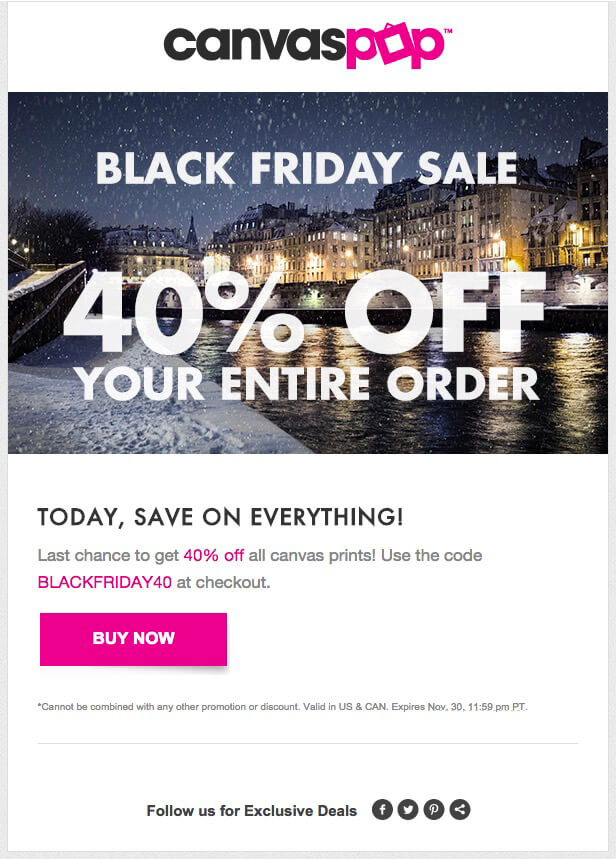
CanvasPop simple Black Friday announcement email
Subject: Black Friday - 40% off everything!
What it is: A simple but well-executed email from CanvasPop announcing their store-wide Black Friday sale.
Why it works: This email is all business. It clearly announces the sale and has a focused call-to-action. Sometimes, keeping things simple is the best way to go.
How to implement it: Take the simple approach to your Black Friday and Cyber Monday sale announcements. Have a clear subject line with the sale discount, and include a call-to-action in your email that brings customers to your homepage or page with the products that are on sale.

2. The Bold Imagery and Animations Email
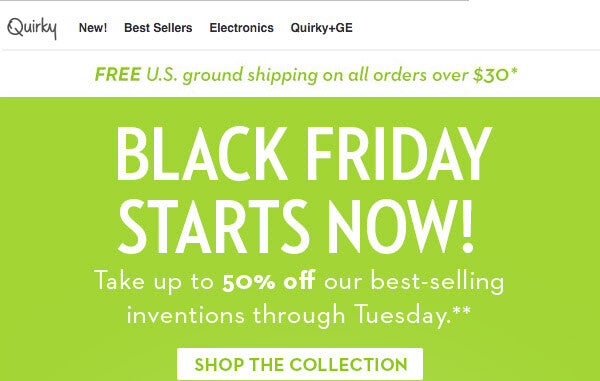
Quirky promotional emailAnimated GIF Black FridayBlack Friday email template
Subject: Don’t wait ’til tomorrow! Take up to 50% off our most popular inventions right now.
What it is: Quirky uses a quirky image animation to announce their Black Friday weekend sale.
Why it works: I don’t often get animated GIFs in my email, let alone one as fun and entertaining as this. This email really stands out from other Black Friday sale announcements that will be barraging customer inboxes.
Also, all the important information is immediately clear. Free shipping, the discount, and the day the sale ends are all there in plain sight.
How to implement it: Start using animated GIFs and very unique imagery in your Black Friday emails, especially if it matches the tone of your brand.
Again, keeping your most important information above the fold is important.

3. The Free Gift Email
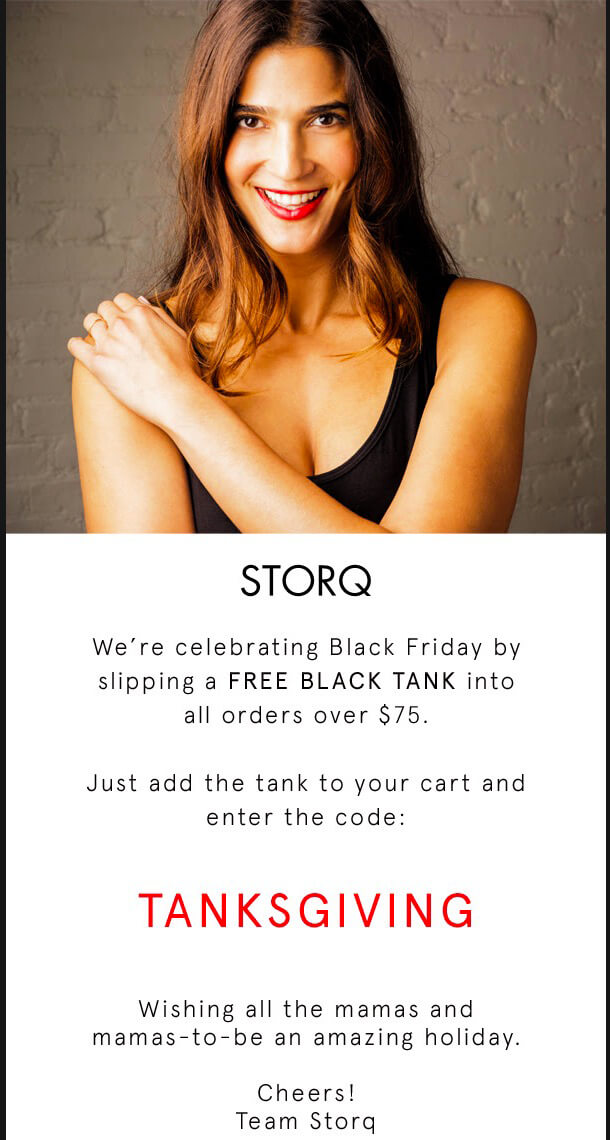
Storq Black Friday email template
Subject: Black Friday + Giving Tanks
What it is: Storq created a free gift coupon instead of offering a store-wide sale.
Why it works: Storq uses Black Friday as an opportunity to increase the average order value in their store. Offering a free gift is an enticing way to get customers to your store on Black Friday.
The email design is also simple and effective. The coupon code really stands out and the instructions are clear and easy to follow.
How to implement it: You can still participate in Black Friday even if your business doesn’t typically discount or you can’t afford to lower your prices. Black Friday gives you a reason to contact your customers, so email them with any offer you can create that weekend.
If you can’t lower your prices, consider offering a free gift with a minimum purchase amount. You caneasily do this within Shopify or with an app from the Shopify App Store to help.
Keep your emails simple and don’t overcomplicate your offer. When it comes to copy, less is often more.

4. The Last-Minute Extended Sale Email
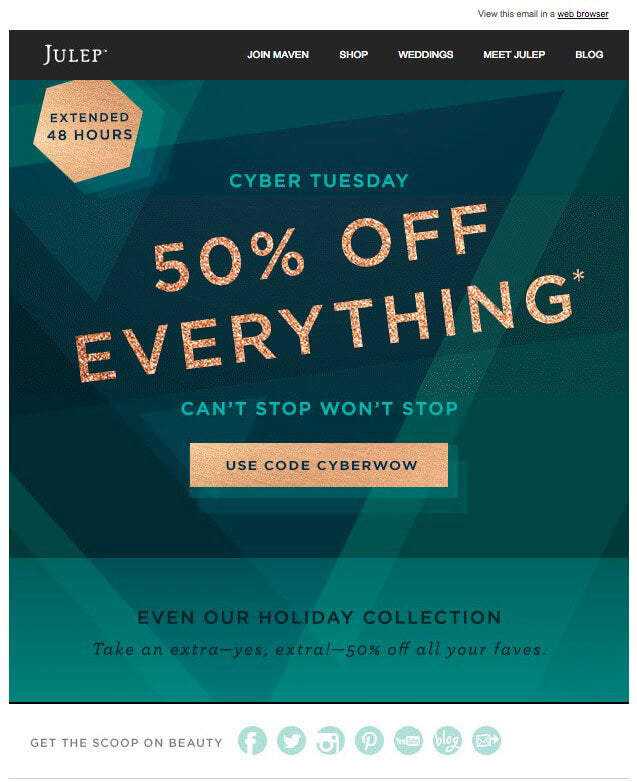
Black Friday announcement email template
Subject: EXTENDED! 50%. Off. Everything.
What it is: Julep extends their Black Friday weekend sale into Tuesday.
Why it works: Not everyone will have the opportunity to check out your Black Friday sale. Extending the sale last-second (and running a sale when competitors just ended theirs) gives customers another chance to purchase from your store.
This email is also effective because it’s unexpected. If you’ve been consistently warning customers about the impending end of your Black Friday sale and then spring a last-second extension, it’s more likely to stick out in people’s inboxes.
Lastly, the email is well designed. The three most important elements in this email contrast well against the rest: “Extended 48 hours,” “50% off everything,” and “use code cyberwow.”
How to implement it: Consider extending your sale and surprising your customers. You can even offer a new discount for the extended sale to get customers off the fence.
Don’t forget to make the most important elements in your email stand out, too. Use Julep’s email design as inspiration.

5. The Black Friday Giveaway Email
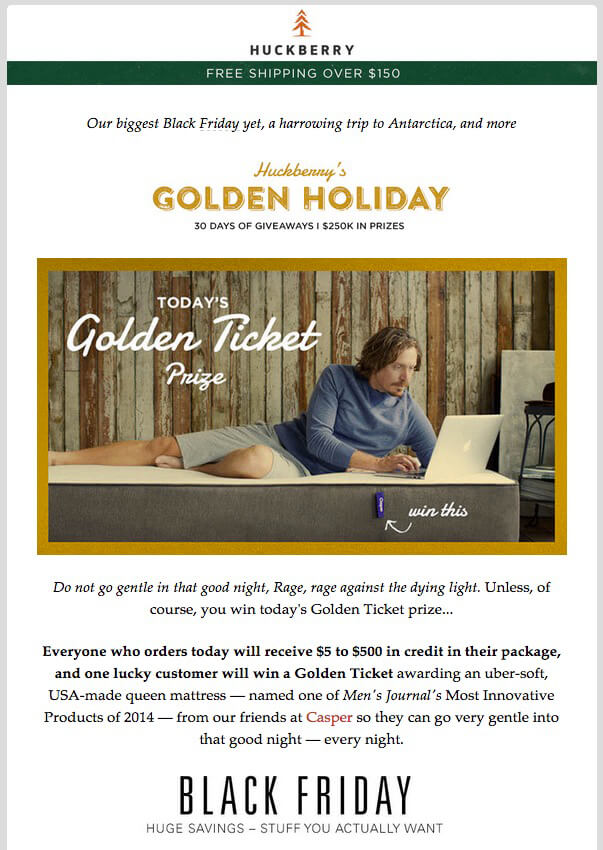
Black Friday giveaway contest email
Subject: Blacked-Out Friday
What it is: Huckberry turns their Black Friday sale into a giveaway.
Why it works: Giveaways and contests can inject even more excitement into a Black Friday sale. Huckberry is giving their customers more incentive to shop on their site during Black Friday by giving each purchase a random entry into their giveaway.
Huckberry also includes more copy in their emails than most stores. Huckberry is very keen on conveying messages and telling stories in their emails, even on Black Friday.
This email in particular is too long to show in this blog post, but below their Black Friday sale announcement are stories, including the harrowing trip to Antarctica mentioned at the top of the email.
Despite being Black Friday, Huckberry hasn’t changed their established tone. Huckberry continues to deliver interesting stories, even in their most promotion-heavy emails.
How to implement it: Run a contest alongside your sale or give every customer that makes a purchase the chance to win a prize. Check out the giveaway apps in our Shopify App Store to help you put this together.
Finally, don’t diverge from your original messaging or style. If you’ve been delivering great content or stories with each email, that doesn’t need to change for Black Friday. Find a way to weave your Black Friday emails into what you’ve been doing well previously. Make it organic.

6. The Black Friday Humor Email

Black Friday humor email example
Subject: Sweats + Shorts = THE SCHWORTS
What it is: Chubbies stays consistent with their tone and branding and uses humor to promote their Black Friday sale on schworts.
Why it works: This email looks a lot different than the a typical Black Friday sale emails. First, the subject line is great. Next, the image of someone lounging on their couch pouring food down their mouth after Thanksgiving is really funny.
There isn’t a lot of copy in this email but it’s still effective at conveying why you need their comfortable shorts. Chubbies also shows you their shorts looking comfortable instead of only telling you that they’re comfortable.
Chubbies also chooses to focus on one product to promote their Black Friday sale instead of announcing a store-wide sale. This is far more effective since leaving customers with too much choice can be overwhelming.
How to implement it: Have fun with your marketing. If it suits your brand, experiment with unique subject lines for your emails and use humorous images.
You don’t need a lot of copy in your Black Friday emails to convey a message. Don’t just tell your customers your shorts are comfortable, show them in an entertaining way.
Lastly, you don’t need to promote several products in your Black Friday email. Promote your Black Friday sale with one product (or a few) instead. Consider choosing your best-selling or most interesting product and promote it on Black Friday to drive traffic.

7. The Scarcity Email
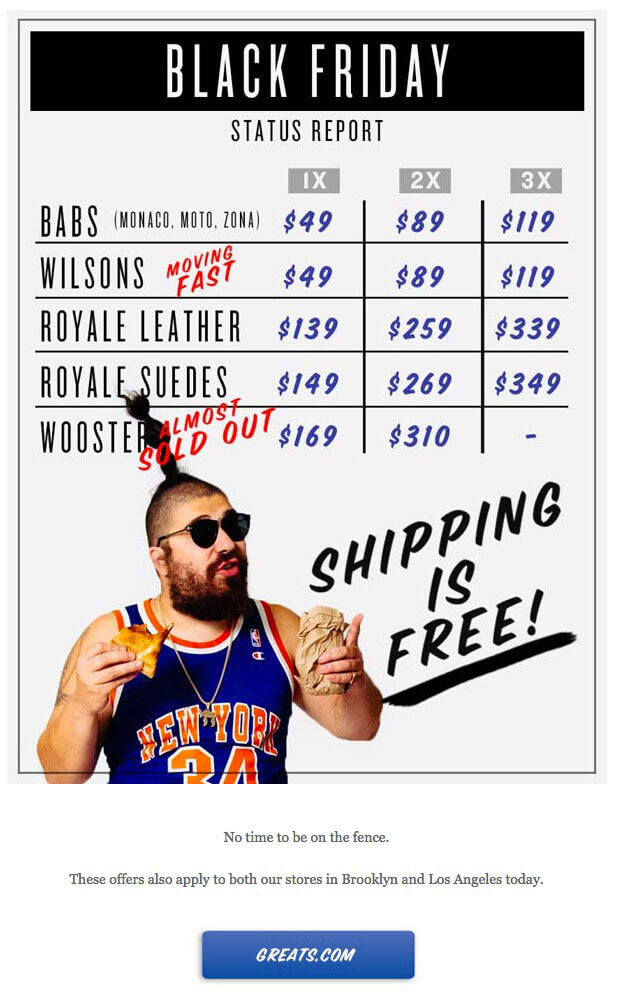
Black Friday scarcity and urgency email sample
Subject: Woosters Almost Sold Out! Black Friday Prices + Free Shipping For A Few More Hours!
What it is: Greats gives their customers a Black Friday status report on the shoes on sale.
Why it works: Greats uses elements of scarcity throughout the email. “Moving fast,” “Almost sold out,” and “No time to be on the fence” creates a sense of urgency. Even the subject line has urgency in it with “Woosters almost sold out!”.
Of course, Greats’ personality shines through in this email as well.
How to implement it: Learn to create scarcity in your email marketing, especially on Black Friday. Create urgency and use your emails to remind your customers that your sale will be ending. Also, when your products are selling like hot cakes, tell people!

8. The Against-The-Grain Email
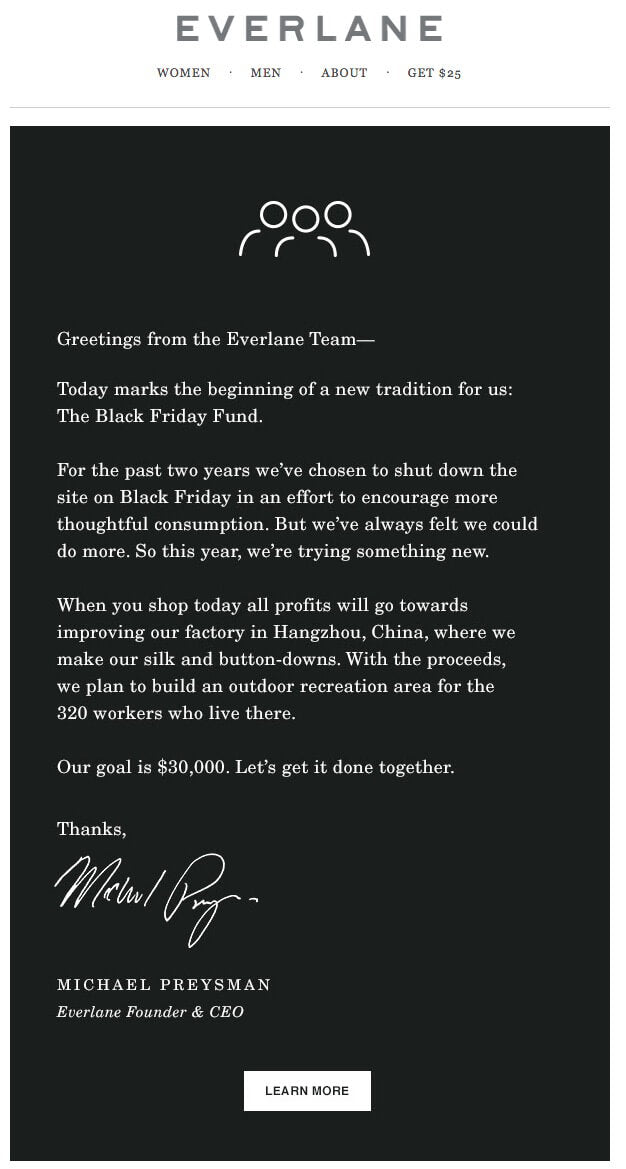
Everlane charity on Black Friday email example
Subject: This Is Not A Sale
What it is: Everlane uses Black Friday as a platform to raise awareness and money for workers in China.
Why it works: The subject line is strong and piques people’s curiosity, encouraging them to open the email to learn more. You don’t often get emails on Black Friday letting you know “this is not a sale.”
It isn’t a bait and switch either; Everlane goes against the grain and promises to give 100% of their Black Friday profit to their factories in China to improve working conditions.
This gesture also helps build Everlane’s brand. It also has the chance to be picked up by news sites social media since it’s unique and generous for a time of year where businesses are focused on profit.
How to implement it: If you’re tired of running the same Black Friday sale every year, or your customers have grown to expect the same from you every year, change things up. Consider making this year’s Black Friday all about your customer or someone else in need.
It could be your opportunity to give back a little while also creating a positive brand image for your store.

5 months of collecting the best growth/marketing hacks which actually worked for startups, giving away all 101 of them

My good friend /u/happyaladdin/ spent 5 months collecting the most effective growth hacks which actually worked for startups. He read books, blogs, articles, videos, podcasts, comments and compiled the best material into a newsletterwhich grew to 17K+ subscribers through invite only over this time period.
Today he is giving away all 101 of the best growth hacks, you can download the full list of TOP 101 growth/marketing hacks ebook today for FREE from Amazon
Here is a list of 10 growth hacks from the book:
1. Leveraging dead competitors
  • Visit AlternativeTo.net to find a huge list of yourcompetitors.
  • Check dead links using browser plugins (Check My LinksDomain Hunter) OR upload a list of URLs to Xenu orScreaming Frog.
  • Google "link: deadcompetitor.com".
  • Contact every website owner to alert them of a broken link and offer a relevant link of yours to replace it. Source: webris.org
2. Hack Product Hunt
  • Do not submit by yourself! Reach out to influencers on PH.
  • Make a win-win offer, ask to submit your website and mark you as the Maker. 
  • Give a specific offer for PH members. 
  • Comment quickly. Comments count as much as upvotes. 
  • Notify your community, but do not ASK them to upvote. And do not give them a direct link to your product. Send them to the main page of Product Hunt instead. Otherwise you will be blocked. 
  • Source: blog.roverlabs.co
3. The magic of headlines
  • Headlines with numbers are 2x more likely to generate clicks vs. "how to" headlines, according to research by Conductor. And a study of 150 000 headlines revealed that odd-numbered headlines have a 20% better CTR than headlines with even numbers.
  • In an analysis of over 3 million headlines, Outbrain found using [brackets] in a headline bumped up CTR by 38%.
  • Source: backlinko.com
4. Parasite SEO (white hat)
  • Mix guest posting + SEO. Authoritative websites can rank for highly competitive keywords much quicker than your low authority site.
  • This article was published on Business News Daily. After only a few weeks, it ranked on page 1 (and still does) for the term ‘app maker’ (searched for over 22,000 times per month), amongst a number of other competitive keywords.
  • Source: www.matthewbarby.com
5. Turn LinkedIn contacts into a list of emails
6. How to impress VIP clients, journalists, investors
  • Try to do it with super personalized Facebook ads:
  • Click Ads tab -> Tools -> Audiences
  • Create Audience -> Custom Audience -> Customer List -> Copy and paste your customer list
  • Paste the email addresses, listed on their Facebook profiles.
  • You need to add at least 30 entries.
  • Create new ads, choose your custom audience, Optimize For: "Clicks To Website", Pricing: "Get the most website clicks at the best price". Voila.
  • Source:mysocialsherpa.com
7. Hack ideas for the 2nd largest search engine
  • Youtube is the 2nd largest search engine in the world. How can you find video ideas for your company and leverage this channel?
  • Click "Source" below.
  • Click "Find new keywords" - "Search for new keywords".
  • Your product or service: [put in anything related to your product: fitness, travel, children, etc.]
  • Keywords to include: how to, instruction, review, tutorial
  • Press [Get ideas]
  • Press [Keyword ideas]
  • Rock on!
  • Source: adwords.google.com
8. Hack Facebook ads
  • First gain “Social proof” (~1000 likes) from Low demand countries (India, Philippines) for $0.005 per post engagement. Then switch target to the high demand, high competition countries.
  • Get 64% less cost per engagement, 920% increase click-through rate. Source: www.upwordsem.com
9. Boost your email opt-in rate by 22%
  • I tested offering a free eBook and a 30-day course in exchange for an email address. This boosted conversions by 6%.
  • By placing a dollar value on the same free information I was offering before, I was able to boost my email opt-in rate by 22%. For example: Free course "..." (valued at $300).
  • Source: www.quicksprout.com
10. Increase YouTube subscribers by 400%

Thursday, July 30, 2015

The 6 Most Innovative Fashion Products Ever Featured On Shark Tank


sharktank2Recently, I dug through the Shark Tank archives to bring you the most amazing beauty products ever seen on the show. In the midst of compiling that list I only got sucked into a vortex of show clips three to seventeen times, which is what I like to call a rousing success. This time around, I’m looking for the lace socks, innovative undergarments, and even workout gear of the Shark Tank world. Which brands were able to make it past their stint on the show to become successful fashion companies? Let’s find out.
grace and lace tunicDuring a dangerous pregnancy that forced her to remain on full bed rest Melissa Hinnant began knitting. Tragically, the Hinnants ultimately lost their baby girl. But what started out as a hobby to pass the time blossomed into a full-fledged business in honor of their unborn daughter, Halle. Melissa has expanded the brand from just socks and boot toppers to a full clothing line, and the couple has partnered with Angel House, contributing a portion of each sale to building orphanages in India.
2. The BoobyPak ($55 – $65)boobypakC.C. Conrad, founder of Boobypak, was on a recent episode of Shark Tank and absolutely crushed it. I was blown away by her poise and guts in such a nerve-wracking situation. She pitched the Boobypak, also known as “the fanny pak for your rack,” and earned an $80,000 investment from Barbara Corcoran for 25% of the company. Seriously, how many times have you tucked your phone and credit card into your bra only to get them all covered in boob sweat? Problem solved.
hoodie pillowSure it looks a little goofy, but I can’t help but want to take the Hoodie Pillow for a spin. Not only can you thread your headphones perfectly through a little portal, but it’s made of sweatshirt material. As someone who is almost exclusively freezing while sleeping, the potential to maintain some of the heat escaping out the top of my head is very appealing. When Rebecca Rescate brought this product to the Tank in season 4 it was actually her second time there (she got a deal in season 2 with a different product), and she got an asking price deal from Robert Herjavec.
Click to the next page to see the “belt that changed the belt,” an amazing way to customize your shirts, and more!

The 6 Most Innovative Fashion Products Ever Featured On Shark Tank

mission beltFor the (or just a) man in your life, I present the Mission Belt. These guys came into the Tank with a clear goal: feed the hungry. They donate $1 from every sale in the form of $25 micro-loans to farmers around the world. It’s an interesting process, and an interesting product. The Mission Belt completely does away with the traditional buckle and holes that get warped over time. Oh, and they’ve recently partnered up to produce licensed collegiate, NHL, and NBA Mission Belts… in case you’re into that kind of thing.
lumiAnother recent Shark Tank episode featured Jesse Genet of Lumi, the innovative way to make your own photo-printed t-shirts with just the sun and their patented Inkodye. Jesse impressively stood her ground with the Sharks, ultimately walking out without a deal. Considering they’ve raised about $268,000 on Kickstarter so far, there’s more than enough interest in the product to make Lumi a big success.
skinnyshirt shark tankTerrible name, genius product. Even though founder Julie Kalimian left the Tank without a deal, her idea is absolutely brilliant and I’m about to buy one right now. I love the look of having a collared shirt underneath a sweater, or a shirt tail hanging out the bottom, but it never looks right unless it you buy one of those attached ones from J.Crew. Presenting…the SkinnyShirt. You can get the same look while keeping a slim line underneath your sweater and being comfortable/not a million degrees. Yes, yes, yes!


Read more: http://www.thegloss.com/2015/03/18/fashion/fashion-beauty-innovative-products-clothing-shark-tank-lumi-boobypak/2/#ixzz3hPlsgWDT


Read more: http://www.thegloss.com/2015/03/18/fashion/fashion-beauty-innovative-products-clothing-shark-tank-lumi-boobypak/#ixzz3hPlJngUF

Monday, July 6, 2015

7 Strategies for Small Business Owners Selling Products on Amazon

amazon.com app logo
By Larry Alton
Selling on Amazon can be a lucrative endeavor for small businesses looking to cash in on some of Amazon’s 168 million monthly visitors. Outpacing even hugely popular retail websites like eBay in terms of traffic and sales, Amazon has grown to be the largest and most commonly utilized marketplace on the web — and the company makes it easy for other businesses to get involved on the platform.
Unfortunately, simply signing up, listing your products, and hoping for the best isn’t enough. The competition is vicious, and if you’re going to be successful, you’ll have to know the tips and tricks that will allow you to stand out.
These seven strategies will give you a fighting chance at success in the gigantic world of Amazon selling:
1. Make Sure a Merchant Account Will Be Worth It. An Amazon Merchant Accountcosts $39.99 a month. There also are a handful of other selling fees, but that subscription will net you virtually unlimited sales. By comparison, selling as an individual costs $0.99 per sale, plus any other selling fees you might incur.
According to Amazon, if you’re going to be selling more than 40 items per month, that $39.99 “unlimited” price is going to be worth it. If you’re just getting started, or if you don’t plan on selling that many items, it may not be in your best interest to commit to such an account. If this is the case, get your feet wet with an Individual seller account, learn the ropes, and then upgrade when you feel comfortable, or when your sales start to exceed the $39.99 threshold.
2. Understand That Price Competition Is Fierce. You want to sell on Amazon because it’s such a popular platform — and almost every other business owner in the world has had the same idea. That means you’re going to be competing with hundreds, if not thousands of competitors selling similar or identical products to yours, some of which are capable of producing or distributing at much lower rates than you. Some may even slash their prices to the point where they lose money just to get an increase in traffic or online visibility.
This doesn’t mean that you can’t be competitive, but you do have to be prepared for the likelihood that your planned price point will probably be undercut. As such, you’ll have to find alternative ways to make your product more appealing.
3. Find a Way To Make Your Products Unique. Rather than trying to compete directly with your competition by listing an identical product, you can circumvent the entire process and list items that are wholly unique to you. Amazon groups items by title, so if you’re selling the same product as a competitor with a higher rank and a lower price point, you’re going to get buried and unseen in the results.
On the other hand, if you list a product nobody else is selling, you’ll be the only item to pop up when users search for it. This is easier said than done, since almost anything you can imagine is already on Amazon, but doing the research and finding a unique way to name or position your products will give you a huge leg up on the competition.
4. Create Synergy Between Your Seller Account and Social Profiles. Having a seller account by itself can be valuable, especially if you invest a lot of time and effort into it, but you’re missing out on a lot of potential reach if you don’t establish synergy between your Amazon account and your company’s social media profiles. Social media is an outlet to the world, giving you a broadcast channel that can exponentially surpass the visibility limits of Amazon. If you find yourself getting buried in the mix, or if you just want to give an extra boost to some of your products, try pushing them on your social channels.
Of course, this is only effective if you take the time to build a social following, but synergy works both ways. As you’re selling, take every opportunity to lead your Amazon customers and visitors back to your social pages. For example, you could send a thank-you email to your purchasers with a request to find you on Facebook, or include your social information with the product when you send it out.
5. Integrate Amazon Into Your E-Commerce Platform. If you’re thinking about selling on Amazon, chances are you already have an e-commerce platform. And since Amazon offers an open API to sellers, you can easily integrate all your Amazon products into your existing e-commerce platform. Users will be able to find, review, and even purchase Amazon products on your unique storefront, giving them an easier, more familiar experience without alienating them from the domain of your online brand.
If you don’t already have an e-commerce platform, it might be worth designing and building one so you have an off-Amazon location for your potential customers to make purchases. This is especially effective if coupled with a content marketing strategy, which can help you improve your search visibility and attract organic traffic.
6. Make Your Customers Feel Special. This goes without saying for any seller, regardless of whether or not they’re on Amazon, but taking the time to give your customers a great experience will go a long way in encouraging repeat traffic. Include some sort of surprise or thank-you with your products when they ship out, such as a discount for a future order or an extra small gift. Additionally, you’ll want to do an audit of your customer service department, and step things up to ensure any inquiries are addressed promptly, personally, and appropriately. Doing this will get you great reviews, which will attract more new buyers in addition to reinforcing the great experiences of your existing buyers.
7. Optimize Your Product Postings. By now, most people are familiar with search engine optimization (SEO) as it relates to ranking in Google searches, but it’s also possible to optimize your products and your seller account to increase your rank and visibility in Amazon searches.
There are two types of factors that Amazon takes into consideration when calculating rank for a given search phrase: performance and relevance. Performance factors have to do with how well you’ve done in the past and how likely you will be successful with new purchases — including how much you’ve sold previously, whether or not your product has a full description and image, how your price compares to others, and your average product rating. Essentially, you can improve your search rank on Amazon by improving your history and making your products more sellable to end users.
Relevance factors are a bit more tricky, and have to do with how relevant your product is to a given query. You can make your product more relevant by having a full, descriptive product title (including both a brand name and an accurate product descriptor), detailed bullet points that describe the product in the product description field, and appropriately filled out “search terms.” Keep in mind that your search terms on Amazon should include any individual words that could apply to your product — don’t try to group them into keyword phrases like you would for Google keyword searches.
Selling on Amazon is like any other marketing strategy. It requires patience, commitment, and ongoing analysis and adjustments before you start to see results. But if you apply these strategies to your campaign from the beginning, you’ll have a nice head start on the competition in terms of visibility and ultimately, sales.